
Truebit (TRU) was never just another crypto coin. It was built to solve a deep, technical problem most blockchains ignore: how to verify complex calculations without paying insane gas fees. Imagine running a full AI model or checking thousands of financial trades on Ethereum - it’s impossible without Truebit’s system. For years, it promised to let developers run heavy computations off-chain, then prove they were correct on-chain using a clever game theory trick. But as of January 2026, that promise has collapsed.
How Truebit was supposed to work
Truebit’s core idea was simple but powerful. Blockchains like Ethereum are great at storing data and executing simple code, but they choke on heavy math - like running machine learning models or verifying cryptographic signatures. Truebit let developers run those tasks on regular computers, then submit the result to the blockchain. But how do you know the result isn’t fake?
The answer was the verification game. One participant, called the solver, ran the calculation and claimed the result. Another, the verifier, could challenge it. If challenged, the protocol triggered a step-by-step dispute process on-chain. The solver had to prove their answer was correct by breaking down the computation into tiny steps. If they couldn’t, they lost their staked TRU tokens. If they could, the verifier lost theirs. This created a strong incentive to only challenge when you were sure the solver was lying.
This system solved what’s called the Verifier’s Dilemma: why should miners bother checking expensive computations if it costs them more in gas than they’d earn? Truebit made it profitable to verify by using token staking and penalties. No zero-knowledge proofs. No fancy cryptography. Just economics.
The TRU token: utility, supply, and how it powered the system
The TRU token was the fuel of this system. You needed TRU to participate - whether you were solving tasks, challenging them, or running verification nodes. Each time a computation was processed, a small amount of TRU was burned, making the token slightly scarcer over time. The total supply was capped at 190 million tokens, with about 112 million in circulation as of early 2026.
TRU wasn’t meant to be a speculative asset. It was designed as a utility token - like paying for cloud computing, but with built-in security. Developers paid in TRU to run their complex tasks. Verifiers earned TRU for catching errors. Solvers earned TRU for completing tasks correctly. The whole economy ran on trust, enforced by token stakes.
Before January 2026, TRU traded around $0.03, with a daily volume near $60,000. It wasn’t a top-10 coin, but it had a loyal following among DeFi builders who needed to do heavy math without blowing up their gas budgets.
Who used Truebit - and why
Truebit wasn’t for everyday crypto users. It was for developers building advanced applications on Ethereum, Polygon, or Avalanche. Projects like MakerDAO used it for complex risk modeling. Aave used it to batch-process liquidation calculations across hundreds of positions at once. These were tasks that would’ve cost thousands of dollars in gas if done on-chain.
Truebit supported standard programming languages - C++, Python, JavaScript - meaning developers didn’t need to learn new tools like zk-SNARKs. That made it far more accessible than alternatives like zk-Rollups. According to Ethereum Foundation’s 2024 assessment, Truebit lowered the barrier for traditional software engineers to build on blockchain.
By December 2025, 47 projects had integrated Truebit, according to DappRadar. Most were DeFi protocols. A few were experimenting with AI inference on-chain. It was a niche, but a vital one.
How Truebit compared to the competition
Chainlink dominated the oracle space with data feeds. The Graph handled indexing. Truebit was the only one focused on computation. That made it unique.
Compared to zk-Rollups, Truebit didn’t need complex cryptographic proofs. That meant faster development cycles and lower expertise requirements. But it had a major downside: speed. A verification game could take 60 to 120 minutes to resolve. For high-frequency trading or real-time payments, that was too slow.
Optimistic Rollups also used dispute periods, but they focused on transaction batching, not complex computations. Truebit filled a different gap - one that required heavy math, not just moving money.
By early 2026, Truebit held about 3.2% of the specialized computation verification market, behind Chainlink’s 62% and API3’s 19%. But in its lane, it was the only serious player.
The January 2026 hack: what went wrong
On January 10, 2026, everything changed.
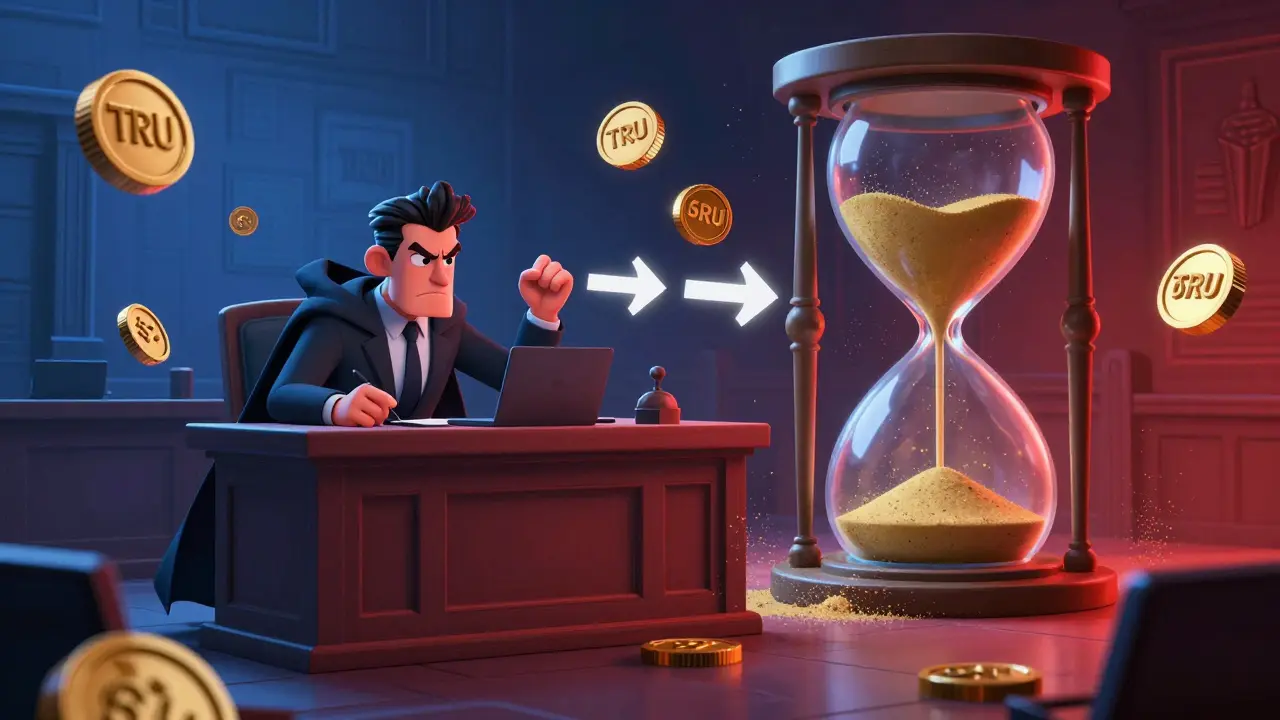
A hacker exploited a flaw in the challenge period logic. The protocol required verifiers to submit challenges within a set time window. But the code didn’t properly validate whether the challenge was actually a valid dispute - it just accepted any input. The attacker submitted thousands of fake challenges, forcing the network into endless verification games. The system became overwhelmed. Miners stopped processing because it cost more gas to resolve disputes than they’d earn.
Then came the payout. The attacker drained approximately $4.2 million worth of TRU tokens from staking pools, exploiting the fact that the protocol didn’t properly track which participants were active in which disputes.
Swarmnetics, a cybersecurity firm, published a post-mortem on January 15, 2026, calling it “a preventable crypto hack.” They pointed to outdated code reviews, lack of automated testing for dispute logic, and no emergency pause function as root causes.
Truebit’s team suspended all operations on January 12. No timeline for recovery. No official statement on whether the code would be fixed or rewritten.
The aftermath: trust is gone
The economic model that made Truebit unique - staking, penalties, incentives - was designed to be self-policing. But the hack proved the system could be gamed if the rules weren’t enforced perfectly.
Industry reaction was swift and brutal. Delphi Digital’s head of research, Kevin Kelly, said, “The economic model that made Truebit unique has been fundamentally compromised.” Decrypt reported that 97% of social media mentions about TRU in the week after the hack were negative. On Reddit, developer u/EthereumCoder89, who once praised Truebit for cutting gas costs by 87%, deleted their post.
Even before the hack, developers complained. GitHub issue #347, titled “Challenge period implementation overly complex for average developer,” had 57 comments. Many said the documentation was unclear and the setup process took weeks.
Now, adoption is frozen. No new integrations. No updates. The roadmap - which included expanding to Solana and adding AI features - is dead.
Is Truebit recoverable?
Technically, maybe. The code could be rewritten. The token could be migrated. A new team could take over.
But trust is the hardest thing to rebuild. Truebit didn’t rely on a central authority. It relied on participants believing the system was fair. The hack shattered that belief. Institutional investors surveyed by Delphi Digital said only 22% would consider re-engaging, even with a full audit.
For now, Truebit is in limbo. The TRU token still trades - at around $0.0289 - but volume has dropped 90% since the hack. The protocol is offline. The community is silent.
Truebit was an ambitious experiment in using game theory to secure computation. It worked - until it didn’t. And in crypto, when the math fails, the money runs.
What’s next for off-chain computation?
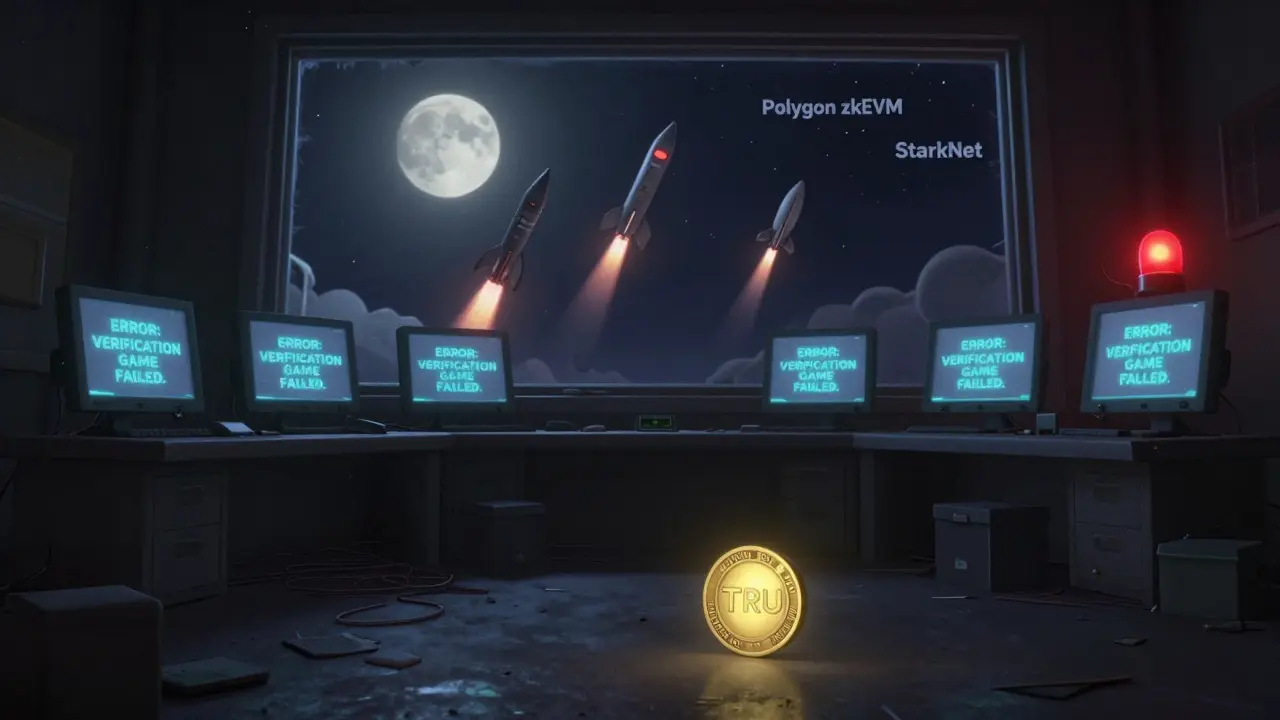
Truebit’s failure doesn’t mean off-chain computation is dead. zk-Rollups are getting faster. New zero-knowledge proof systems are reducing verification times to seconds. Projects like Polygon’s zkEVM and StarkNet are handling complex logic with near-instant finality.
But none of them use the same economic incentive model. They rely on cryptography, not staking games. That makes them harder to build for, but also harder to hack.
Truebit showed that trust can’t be built on incentives alone. It needs layers of security, testing, and redundancy. The lesson isn’t that off-chain computation doesn’t work. It’s that if you’re betting your system’s security on players being rational, you better have a backup plan.

Ashok Sharma
January 23, 2026 AT 19:21Truebit was an interesting experiment, but it showed us that even the best economic models can fail without solid engineering. The verification game sounded elegant, but real systems need more than incentives-they need redundancy, testing, and fallbacks. This isn’t the end of off-chain computation, just a reminder that trust must be built with code, not just math.
Margaret Roberts
January 25, 2026 AT 06:26Let’s be real-this was a controlled demolition. The team knew the challenge period was a joke and let it go live anyway. They wanted to dump TRU on retail fools and vanish. Look at the timing-right after the last big whale exit. This isn’t a hack, it’s a rug pull with a whitepaper.
Tselane Sebatane
January 26, 2026 AT 20:20Look, I know people are saying it’s dead, but hear me out-this is exactly the kind of failure that sparks the next big thing. Truebit didn’t fail because the idea was bad-it failed because people were too lazy to build it right. Imagine if someone took this code, fixed the dispute logic, added automated audits, and made it plug-and-play for devs? We could have had the most secure computation layer on Ethereum. It’s not over-it’s just waiting for someone brave enough to rebuild it right.
Jonny Lindva
January 27, 2026 AT 05:46Honestly, I used Truebit for a small DeFi tool last year. It was clunky, but it saved me $2k in gas on one batch job. The docs were a mess, yeah, but the devs were responsive on Discord. I’m sad to see it go. If anyone’s rebuilding this, I’d love to help test it. We don’t need another zk-proof nightmare-we need something simple that just works.
Jen Allanson
January 29, 2026 AT 05:26It is regrettable that the protocol’s design philosophy prioritized theoretical elegance over operational resilience. The absence of an emergency pause function, coupled with insufficient formal verification of dispute resolution logic, constitutes a fundamental dereliction of duty on the part of the development team. One cannot ethically deploy a system of this magnitude without exhaustive stress-testing and multi-party code reviews. This is not a market failure-it is a governance failure.
Harshal Parmar
January 30, 2026 AT 20:51Man, I remember when I first heard about Truebit. I thought, ‘Finally, someone gets it!’ I was running a bunch of AI inference jobs on-chain and was about to go broke paying gas. Truebit cut my costs by like 90%. I even told my buddy at the blockchain meetup about it. Now? I just feel dumb for believing it. But hey, that’s crypto, right? You learn fast or you get left behind. I’m not mad-I’m just done trusting ‘elegant’ systems that don’t have a kill switch. Next time, I’m going with something that’s been battle-tested for years, not a cool idea on a GitHub repo.
Darrell Cole
February 1, 2026 AT 05:57Everyone’s acting like this was a surprise but the code was always garbage. The verifier game was a joke. Anyone with half a brain could’ve spotted the flaw in the challenge window validation. And don’t get me started on the tokenomics-burning TRU? That’s just a gimmick to make people think it’s deflationary when in reality the supply was always gonna be flooded by whale dumps. The real problem? People thought game theory could replace code audits. That’s not innovation that’s delusion.
Matthew Kelly
February 2, 2026 AT 03:43Rest in peace Truebit 😢 I used it for a small project and it worked great until the hack. The devs were nice, the community was small but real. I’m not giving up on off-chain computation-just waiting for the next one that doesn’t skip QA. If anyone’s building it, hit me up. I’ll test it for free. Just don’t make me learn zk-SNARKs again.
Dave Ellender
February 2, 2026 AT 18:39Truebit’s collapse isn’t just a technical failure-it’s a cultural one. We built a system that assumed participants would act rationally, but in crypto, incentives always get gamed. The lesson isn’t that computation verification is impossible. It’s that we need to design for human irrationality, not just economic theory. Maybe the next generation will do better.
Adam Fularz
February 4, 2026 AT 16:24Truebit was always a scam. The team raised 12 mil in 2021 and did nothing but update the website. The whole ‘verification game’ was just a buzzword to attract devs who didn’t know zk-rollups existed. Now the token’s dead and nobody cares. Classic. The only thing worse than a failed project is a failed project that makes you feel dumb for believing in it.