
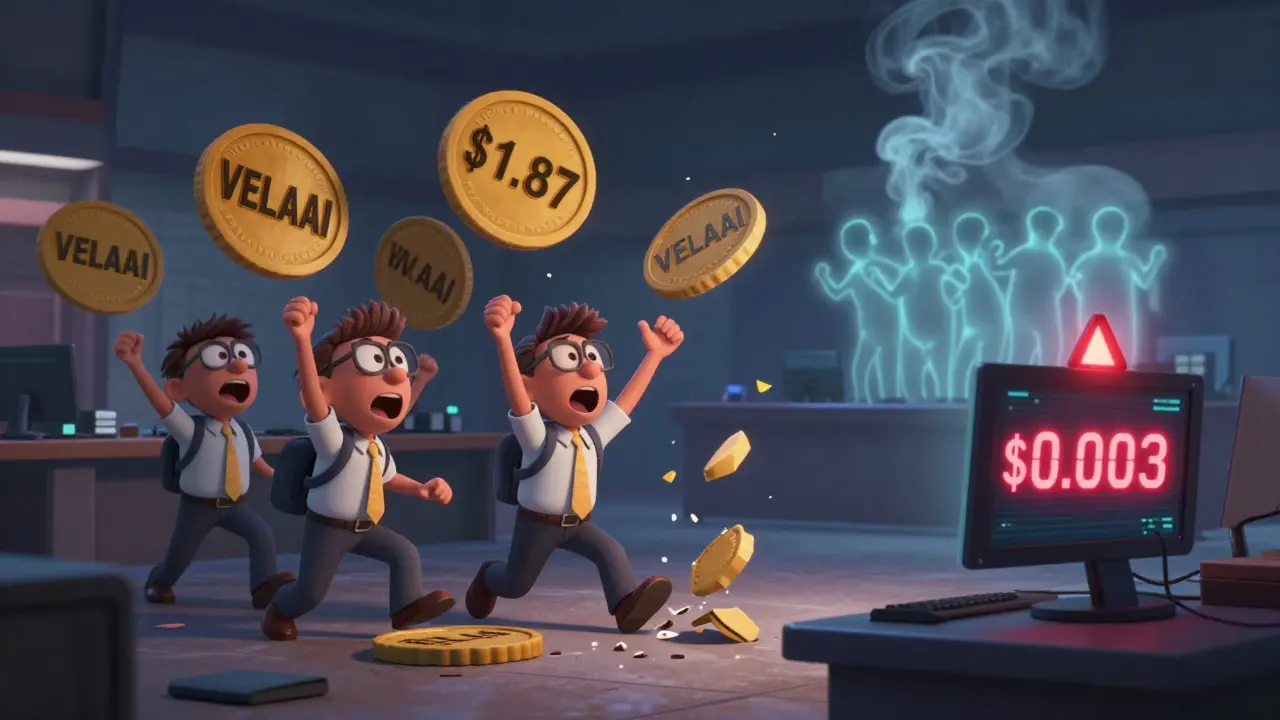
VELAAI, also known as VELA AI, is a cryptocurrency that launched in May 2025 with a bold promise: to connect traditional finance with decentralized finance using AI and cross-chain tech. Sounds impressive? Maybe. But here’s the truth - it spiked to $1.87 in its first 24 hours, then collapsed over 99%. Today, it’s trading at around $0.003, with some platforms showing it at $0.15 and others at $0.0005. If you’re wondering whether VELAAI is a scam, a gamble, or something real, you’re not alone. Let’s cut through the noise.
What Is VELAAI Actually Built On?
VELAAI runs on the Binance Smart Chain a blockchain platform developed by Binance that supports smart contracts and decentralized applications with lower fees than Ethereum. That means it’s not a standalone network - it piggybacks on existing infrastructure. This isn’t inherently bad. Many tokens do this. But it does mean VELAAI doesn’t control its own security or transaction speed. It’s dependent on Binance Smart Chain’s uptime, fees, and network congestion.
The project claims to use AI to automate asset tokenization and market-making. In plain terms, it says its smart contracts can analyze real-world assets - like real estate or commodities - and create digital versions of them on-chain. Then, it uses AI to predict trading patterns and adjust liquidity automatically. Sounds futuristic? It’s not clear how this works in practice. No public code, no audit reports, and no verifiable examples of assets being tokenized. That’s a red flag.
Tokenomics: 1 Billion Tokens, Zero Transparency
VELAAI has a total supply of 1 billion tokens. No more. No less. That’s straightforward. But here’s where it gets messy:
- Circulating supply: Unknown. No official source states how many tokens are actually in traders’ hands.
- Exchange liquidity: Only 1% (10 million tokens) were allocated for initial trading on Gate.io. That’s tiny.
- Locked tokens: No clear schedule. Are 90% sitting in wallets? In team hands? In a vault? No one says.
This lack of transparency is dangerous. If 80% of the supply is held by a few addresses, a single sell-off could crash the price again. And that’s exactly what happened after the initial pump.
Price History: A Rollercoaster with No Safety Rails
VELAAI’s price history is a textbook case of a meme-style launch gone wrong:
- May 13, 2025: Listed on Gate.io at $0.01. Trading volume jumped fast.
- May 14, 2025: Hit $1.87 - a 187x increase in one day. Social media exploded. YouTube influencers promoted it as "the next Bitcoin."
- June-August 2025: Price dropped 90% as early buyers cashed out. Liquidity dried up.
- September 7, 2025: Plunged to $0.000063063 - a 99.6% drop from its peak.
- February 2026: Trading between $0.003 and $0.15, depending on the platform.
Why the wild swings? Two reasons: low liquidity and no real utility. With only $500K traded daily across all exchanges, a single large order can move the price 20% in minutes. That’s not a market - it’s a casino.
Where Can You Trade VELAAI?
VELAAI is listed on a handful of exchanges, but only one is consistently active:
- Gate.io: The main exchange. VELAAI/USDT pair handles most of the trading volume - around $120K daily.
- CoinCarp: Shows data but doesn’t let you trade.
- BitMart, MEXC, OKX: Listed, but with near-zero volume.
- Binance: Not listed. Some sites falsely claim Binance supports it. Don’t believe them.
Notice something? There’s no major exchange supporting VELAAI. No Coinbase. No Kraken. No KuCoin. That’s a sign. Legitimate projects with real tech and user demand get listed on top exchanges. VELAAI didn’t. Why? Because it lacks the volume, the compliance, and the track record.
Market Sentiment: Neutral on Paper, Bearish in Reality
Some sites say the Fear & Greed Index for VELAAI is "Neutral" at 50. But look deeper:
- Price is 99.6% below its all-time high.
- Market cap is effectively $0 on CoinGecko and CoinCodex.
- Trading volume is less than 1% of major coins like SOL or ETH.
- No developer activity on GitHub. No updates since July 2025.
Real investors aren’t holding. They’re not buying. They’re watching. And if you’re thinking of buying because "it’s cheap," remember: a $0.003 coin can drop to $0.0001 just as easily as it can rise to $0.01.

Should You Invest in VELAAI?
Let’s be blunt. VELAAI is not a long-term investment. It’s a high-risk speculation.
If you’re considering it:
- Only risk what you can afford to lose 100%. This isn’t a portfolio staple - it’s a lottery ticket.
- Don’t use leverage. CoinCarp warns against perpetual contracts. They’re asking for a margin call.
- Don’t believe hype. If you see "100x potential" on TikTok or Telegram, walk away. Those posts are paid promotions.
- Check the whitepaper. If it’s full of buzzwords like "AI-driven cross-chain assetization" without technical details, it’s a smoke screen.
The project’s vision - bridging traditional finance and DeFi - is valid. But VELAAI isn’t delivering it. There’s no proof of working products, no partnerships with real institutions, no audits. Just a token that had a flash-in-the-pan moment.
What’s Next for VELAAI?
Without a clear roadmap, active development, or exchange listings, VELAAI’s future is uncertain. The team hasn’t released a single update since August 2025. No blog posts. No Twitter threads. No GitHub commits.
If they come back with:
- An audited smart contract
- A working demo of asset tokenization
- A partnership with a real financial service
…then maybe it’s worth a second look. But as of now? It’s a ghost ship.
Final Verdict
VELAAI is not dead. But it’s not alive either. It’s in limbo - a token with no real use, no transparency, and no trust. Its price is a mirror of its credibility: extremely low.
If you’re looking for crypto with real innovation, look elsewhere. If you’re looking for a high-risk gamble with a story, then VELAAI might give you a thrill - but it won’t give you returns.
Is VELAAI a scam?
VELAAI isn’t a confirmed scam, but it has all the warning signs: no transparency, no team info, no audits, and extreme price manipulation. It launched with hype, crashed hard, and hasn’t delivered any real product since. Many investors lost money. Treat it as high-risk speculation, not a legitimate investment.
Can VELAAI reach $1 again?
Technically, yes - if trading volume spikes and hype returns. But realistically? Unlikely. To hit $1, VELAAI would need $1 billion in market cap. It currently trades at less than $1 million. That’s a 1,000x increase. No major exchange supports it. No real utility exists. Without those, a $1 price is fantasy.
Why does Binance show a different price than CoinGecko?
Binance doesn’t list VELAAI. Any price shown on Binance’s site is either outdated, from a fake pair, or pulled from another exchange. CoinGecko and CoinCodex aggregate data from real trading pairs - mainly Gate.io. Trust those numbers. Ignore Binance’s data - it’s misleading.
Is VELAAI listed on Coinbase or Kraken?
No. VELAAI is not listed on Coinbase, Kraken, KuCoin, or any major regulated exchange. It’s only available on smaller platforms like Gate.io, MEXC, and BitMart. That’s a major red flag. Legitimate projects get listed on top exchanges after meeting strict compliance standards.
Can I stake VELAAI to earn interest?
Some platforms claim you can stake VELAAI, but there’s no proof of secure staking contracts. No audits. No lock-up periods published. Staking a token with zero market cap and no team transparency is extremely risky. You could lose your entire stake. Avoid staking unless you’re willing to lose everything.

Tabitha Davis
February 24, 2026 AT 05:33Arya Dev
February 25, 2026 AT 07:30Leslie Cox
February 25, 2026 AT 23:40Derek Sasser
February 27, 2026 AT 12:08Neeti Sharma
February 28, 2026 AT 15:26Fiona Monroe
March 1, 2026 AT 08:04Sriharsha Majety
March 2, 2026 AT 20:48Don B.
March 3, 2026 AT 13:10Vishakha Singh
March 5, 2026 AT 10:39Molley Spencer
March 6, 2026 AT 15:51John Fuller
March 8, 2026 AT 13:08Andrew Hadder
March 9, 2026 AT 06:41Nadia Shalaby
March 9, 2026 AT 11:33