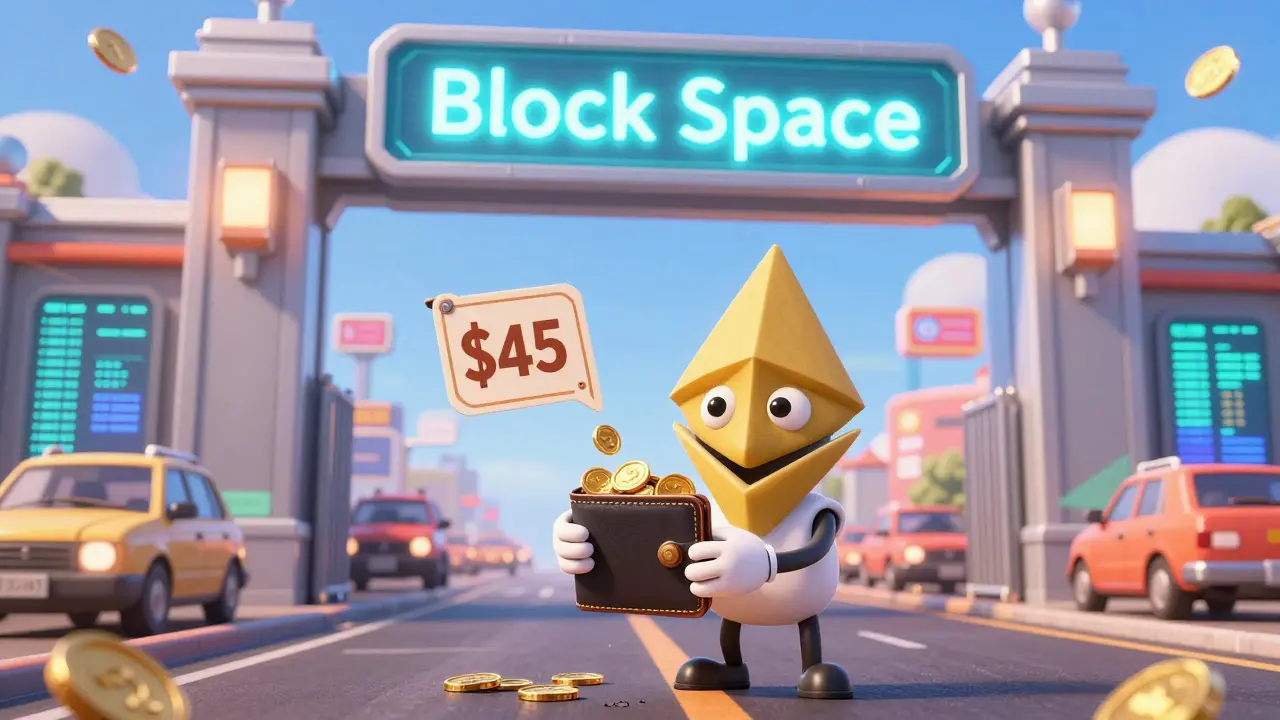
You click "Swap" on your favorite decentralized finance app, see a fee of $45 pop up, and immediately hit cancel. It feels like robbery. For years, this was the standard experience for anyone trying to use Ethereum. But here is the twist: that high price tag isn't a bug; it's a feature of how the network protects itself. And more importantly, the story has changed drastically in 2025 and 2026. While the headlines often scream about expensive transactions, the reality on the ground is much more nuanced-and much cheaper if you know where to look.
The Core Problem: Block Space Is Scarce
To understand why fees spike, you have to stop thinking of Ethereum as a bank account and start thinking of it as a global computer with limited processing power. Every time you send ETH, mint an NFT, or trade a token, you are asking every validator on the network to perform calculations to verify your action. This computation requires energy and hardware resources.
Gas is the unit of measurement for this computational work. Think of it like fuel for a car. A simple transfer uses a little gas (about 21,000 units). A complex interaction with a smart contract, like swapping tokens on Uniswap, uses a lot more (often 150,000 to 300,000 units). The more complex the task, the more gas you burn.
The bottleneck is block space. Ethereum produces a new block roughly every 12 seconds. Each block has a strict limit on how many transactions it can hold-currently capped at 30 million gas units per block. When demand exceeds supply, users enter a bidding war. If you want your transaction included in the next block, you have to pay more than everyone else. This is basic economics: scarce resource + high demand = high prices.
How EIP-1559 Changed the Game
If you started using crypto before August 2021, you remember the old auction system. You had to guess what fee would get your transaction through. Guess too low, and your transaction sat there forever. Guess too high, and you overpaid.
Then came EIP-1559. This upgrade introduced a dual-component fee structure that makes pricing more predictable:
- The Base Fee: This is a minimum price set by the protocol itself. It adjusts dynamically based on network congestion. If the previous block was full, the base fee goes up. If it was empty, the base fee drops. Crucially, this fee is burned, meaning it is permanently removed from circulation. This creates deflationary pressure on ETH.
- The Priority Fee (Tip): This is optional money you give directly to validators to incentivize them to include your transaction sooner rather than later.
This system meant that during normal times, you could predict exactly what you’d pay. However, during viral moments-like a popular NFT drop or a meme coin launch-the base fee can skyrocket because the network is simply overwhelmed.
Why Fees Spiked Recently (And Why They’re Dropping)
In early 2025, many users noticed their average transaction cost hovering around $0.40. That’s a massive improvement from the $86 swaps of 2021. This drop wasn't magic; it was engineering. The Dencun Upgrade significantly reduced the cost of data availability on the mainnet, making it cheaper for Layer 2 networks to post proofs back to Ethereum. This indirectly lowered congestion on Layer 1 by encouraging more activity to move off-chain.
However, spikes still happen. In February 2025, the launch of the WLFI token caused gas prices to surge from under 1 gwei to over 100 gwei. Transfers exceeded $145 again. Why? Because thousands of bots and users tried to interact with the same smart contract simultaneously. The network couldn't process them all fast enough, so the base fee adjusted upward aggressively to clear the backlog.
As of May 2026, the average gas price sits around 2.7 gwei. Daily total fees paid on the network have dropped by 70% compared to peak periods. But volatility remains. One viral event can still break the bank if you aren't careful.

The Hidden Cost: Transaction Complexity
Not all transactions are created equal. Your wallet might show you a flat dollar amount, but behind the scenes, the complexity varies wildly. Here is a breakdown of typical gas usage:
| Transaction Type | Estimated Gas Units | Complexity Level |
|---|---|---|
| Simple ETH Transfer | 21,000 | Low |
| ERC-20 Token Transfer | 50,000 - 65,000 | Medium |
| NFT Minting | 100,000 - 200,000 | High |
| DeFi Swap (Uniswap) | 150,000 - 300,000+ | Very High |
| Lending/Borrowing | 200,000 - 400,000 | Very High |
If you are doing complex operations, you will always pay more. There is no way around it. The network must execute every line of code in your smart contract interaction. This is why simple payments feel cheap while interacting with decentralized exchanges feels expensive.
The Solution: Layer 2 Scaling
If Layer 1 Ethereum is the congested highway downtown, Layer 2 networks are the express lanes built alongside it. These networks process transactions off the main chain and then bundle them together to settle on Ethereum periodically. This preserves Ethereum’s security while drastically reducing costs.
Major Layer 2 solutions include:
- Arbitrum: Uses optimistic rollups to batch transactions. Known for high compatibility with existing Ethereum tools.
- Optimism: Another optimistic rollup leader, focusing on shared sequencer infrastructure.
- Base: Coinbase’s Layer 2 solution, bringing easy onboarding for mainstream users.
- Polygon: Offers various scaling technologies, including zk-rollups, for ultra-fast finality.
On these networks, fees are typically 90-99% lower than on Ethereum mainnet. A swap that costs $40 on Layer 1 might cost $0.05 on Arbitrum. Most daily DeFi activity has migrated here. If you are still paying high fees in 2026, you are likely transacting on Layer 1 when you should be on Layer 2.

How to Minimize Your Gas Costs Today
You don't need to be a developer to save money on gas. Here are practical steps you can take right now:
- Use Layer 2 Networks: Whenever possible, bridge your assets to Arbitrum, Optimism, or Base. Keep only small amounts of ETH on Layer 1 for staking or voting.
- Time Your Transactions: Gas fees follow human behavior. They are typically highest during weekdays, especially between 9 AM and 5 PM EST. Weekend nights and early mornings often see fees 25-40% lower.
- Check Gas Trackers: Use tools like ETH Gas Station or GasNow to see real-time recommendations. Don’t just accept the default "fast" setting in your wallet unless it’s urgent.
- Batch Transactions: If you need to do multiple actions (e.g., approve a token and then swap it), look for interfaces that allow batching. Some wallets and dApps let you combine approvals into single transactions, saving you one gas payment.
- Avoid Viral Events: If a new token or NFT collection launches, expect chaos. If it’s not life-or-death, wait 24 hours for the frenzy to die down before interacting.
Is Ethereum Still Worth It?
Critics argue that high fees kill usability. But look at the bigger picture. Ethereum processes over 1 million transactions daily and holds over $50 billion in total value locked across its ecosystem. It remains the most secure, decentralized smart contract platform in existence. Alternatives like Solana or Binance Smart Chain offer lower fees but often compromise on decentralization or have suffered from outages.
The trend is clear: Ethereum is becoming a settlement layer. It secures the value, while Layer 2s handle the speed. As infrastructure improves-with better bridges, auto-batching tools, and gas hedging services-the friction will continue to drop. By 2026, the average user shouldn't even notice they are on Ethereum; they just know their transaction went through quickly and cheaply.
What is the average gas fee on Ethereum in 2026?
As of May 2026, the average gas price on Ethereum mainnet hovers around 2.7 gwei, translating to approximately $0.40-$0.50 for a standard transaction. However, this can spike dramatically during periods of high congestion, such as major token launches or NFT mints, where fees can exceed $100 temporarily.
Why did Ethereum gas fees drop so much after the Dencun upgrade?
The Dencun upgrade introduced proto-danksharding (EIP-4844), which reduced the cost of data availability on the mainnet. This made it significantly cheaper for Layer 2 networks to post transaction data to Ethereum. As a result, more activity moved to Layer 2s, reducing congestion on Layer 1 and lowering base fees for those who still use it.
Are Layer 2 networks safe to use?
Yes, major Layer 2 networks like Arbitrum, Optimism, and Base inherit security from Ethereum mainnet. They process transactions off-chain but periodically submit proofs to Ethereum. If a fraud occurs, it can be challenged on the mainnet. While no system is 100% risk-free, they are considered highly secure for daily transactions.
How does EIP-1559 affect my gas fees?
EIP-1559 split fees into a base fee (burned) and a priority fee (tip). This makes fees more predictable. During low traffic, the base fee drops, saving you money. During high traffic, it rises automatically. You can also set a maximum priority fee to avoid overpaying tips during calm periods.
When are Ethereum gas fees lowest?
Gas fees are typically lowest during weekends and early morning hours in the US (EST timezone), when network activity from institutional traders and developers is minimal. Avoid transacting during major market open hours or right after viral crypto news breaks.
